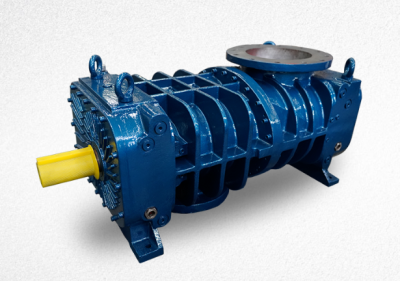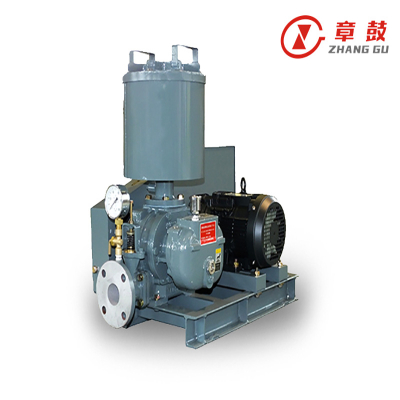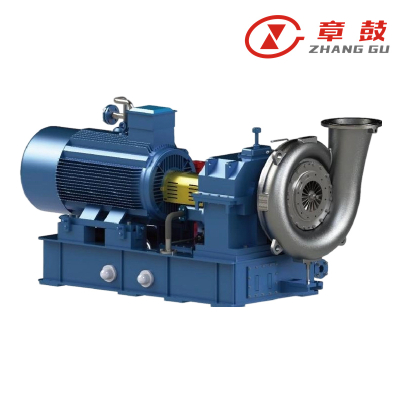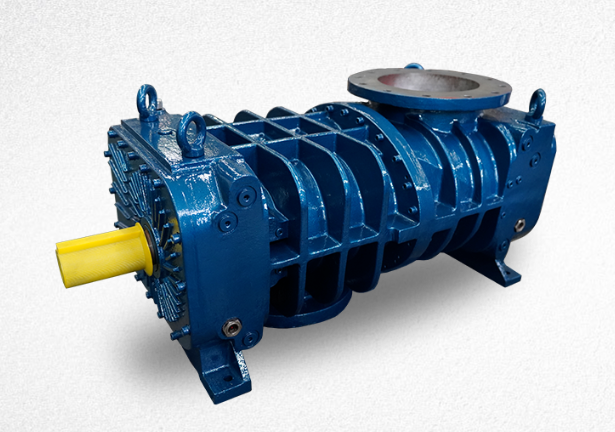
Metallurgical screw blower
1. The rotor uses a large shaft diameter design, which provides increased shaft rigidity and load-bearing capacity.
2. The support end is equipped with a combination of four-point radial thrust bearings and cylindrical roller bearings, which provides the bearings with sufficient load-bearing capacity and stability under extreme conditions, prolonging the service life of the bearings.
3. The housing is constructed with a center joint, which ensures uniform stress distribution and increases the overall load-bearing capacity of the housing; the design with large reinforced ribs increases the housing rigidity, ensuring reliable operation at high pressures.
4. A splash lubrication system is used, which results in low power consumption for oil mixing, ensuring a stable supply of lubricating oil to gears and bearings.
A screw compressor consists of a pair of parallel, meshing male and female screws and is the most widely used type of rotary compressor. It is divided into single-screw and twin-screw types, and the term "screw compressor" generally refers to a twin-screw compressor. It was not until 1934 that A. Lysholm of the Royal Institute of Technology in Sweden laid the foundations for this technology and began its industrial application, leading to rapid development. A screw compressor is a positive-displacement piston compressor, and its operating cycle is based on the rotary motion of a pair of meshing male and female screws. Suction, capture, compression, and release of gas are accomplished through periodic changes in volume between the teeth.
The compression principle of a screw compressor:
Suction process:
As the rotor rotates, the toothed gap volume formed by the main and auxiliary rotors gradually increases. This volume is connected only to the suction port, and outside air is drawn into the toothed gap volume. When the toothed gap volume reaches its maximum, it is disconnected from the suction port, and suction ends. This is called the "suction process."
Sealing and transportation process:
At the end of the suction process, the teeth of the main and auxiliary rotors are firmly seated against the housing, and the air within the toothed gap is trapped in a closed chamber formed by the main and auxiliary rotors and the housing, a process known as the "sealing process." As the two rotors continue to rotate, the teeth of the main and auxiliary rotors mesh with each other, and the engagement surface gradually moves toward the outlet end. The air in the toothed gap also moves toward the outlet end, a process known as the "conveying process."
Compression and oil injection process:
Specific application scenarios for each stage of the process
1. Agglomeration workshop
Oxidation during wet gas cleaning
Provides a stable supply of low pressure air for the oxidation of sulfites to gypsum, without contaminating the desulfurization reagents with oil or gas, ensuring compliance with environmental regulations.
Pulse blowing of filter bags
Used to clean filter bags, stabilize air pressure, prevent dust clogging, improve dust removal efficiency and reduce downtime for cleaning.
Fluidization of materials in a silo
Facilitates the feeding of agglomerate and raw materials into silos, prevents clogging and arching, ensuring uniform and stable unloading.
2. Iron production workshop in a blast furnace
Blast furnace gas transportation and injection
Provides injection and transportation of blast furnace gas to blast heaters and steam boilers, allowing for the utilization of waste heat, saving energy and reducing consumption.
Injection of finely divided coal to aid combustion
Transporting crushed coal at low pressure, replacing part of the coke, reducing raw material costs for steelmaking.
Purging of pipelines and equipment
Daily blowout of furnace ducts, vents and dust removal ducts to clear accumulated dust and debris.
3. The process of steelmaking and refining of converter steel
Negative pressure compensated furnace throat dust removal
Maintaining negative pressure in the smoke cap of a steelmaking furnace to prevent dust from escaping with gases and improve conditions in the workshop.
Bottom blowing in steel refining LF/RH
Gas blowing to stir molten steel, equalize temperature and composition, remove inclusions and improve steel quality.
Auxiliary blowing of continuous casting machine
Blowing air over the casting surface and providing an auxiliary cooling air flow to improve the surface quality of the ingots.
4. Steel mill wastewater treatment plant
Aeration supply for biochemical pools
Aeration of steel mill wastewater and complex biochemical treatment of factory sewage, supplying oxygen to microorganisms and destroying COD and ammonia nitrogen.
Air supply for sludge transport and drying
Pneumatic sludge transport and assistance in sludge drying, facilitating subsequent filter pressing.
5. Plant Engineering Support
Ventilation of workshops and air supply for cooling equipment
Assistance in supplying instrument air, supplying low-pressure constant air for the plant pipeline network
Air source for pneumatic transportation of raw materials
About Us
Shandong Zhangqiu Blower Co., Ltd. (abbreviated as "ZhangGu," stock code: 002598) is one of the most reputable and influential manufacturers and suppliers in China, with nearly 50 years of experience in R&D and production. The company has established two Sino-Japanese joint ventures and founded the first American branch in the Chinese blower industry. Today, ZhangGu has developed into a large, modern enterprise engaged in the design and production of root blowers/pumps, turbo blowers, industrial pumps, mills, pneumatic conveying systems, electrical control devices, and MVR systems. In July 2011, ZhangGu was successfully listed on the Shenzhen Stock Exchange.