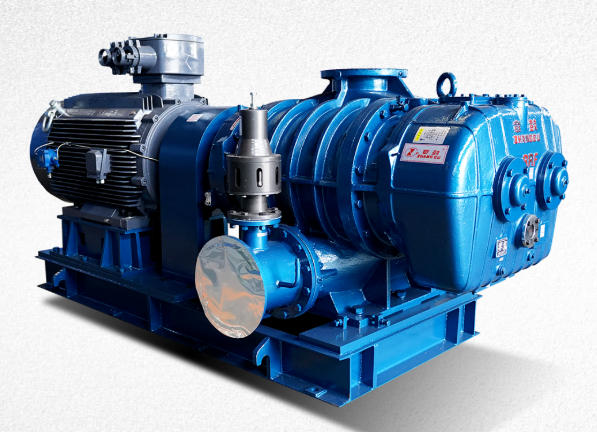
Rotary air compressor
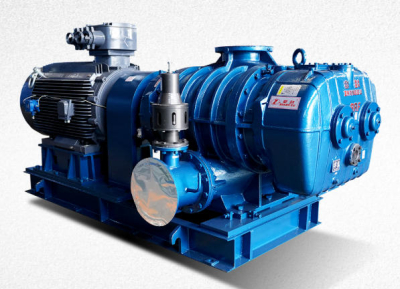
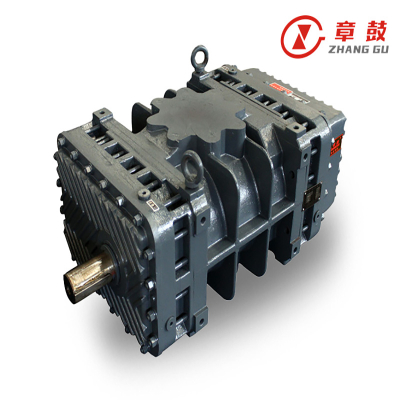
A rotary air compressor is a positive displacement fan. The end surfaces of the impellers and the front and rear fan covers operate on the principle of using two molded rotors to move and compress gas in a cylinder through relative motion. This type of fan has a simple design and is easy to manufacture. Widely applied in aquaculture oxygenation, wastewater treatment aeration, cement transportation, and also more suitable for gas conveying and boosting systems in low pressure environments. Also can be used as a vacuum pump, etc.
A rotary air compressor is a positive displacement fan. The end surfaces of the impellers and the front and rear fan covers operate on the principle of using two molded rotors to move and compress gas in a cylinder through relative motion. This type of fan has a simple design and is easy to manufacture. Widely applied in aquaculture oxygenation, wastewater treatment aeration, cement transportation, and also more suitable for gas conveying and boosting systems in low pressure environments. Also can be used as a vacuum pump, etc.
Characteristics
Thanks to the use of a three-blade rotor design and optimal design at the inlet and outlet of the housing, the fan has low vibration and noise.
The impeller and shaft are made as a single unit, eliminating impeller wear. Fan operating parameters remain constant over time, and the fan itself can operate continuously for extended periods.
The fan's volumetric performance is high, volumetric efficiency is high, and the design is compact. The installation method is flexible and adjustable.
A wide range of models are available to meet the needs of different users for different purposes.
terms of Use
1. The inlet temperature of the transported medium usually does not exceed 40 °C.
2. The particle content in the medium should not exceed 100 mg/m³, and the maximum particle size should be half the minimum working clearance.
3. The bearing temperature during operation should not exceed 95°C, and the lubricating oil temperature should not exceed 65°C.
4. The working pressure should not exceed the pressure increase range indicated on the nameplate.
5. The clearances between the impeller and the housing, between the impeller and the side plate, and between the impellers were adjusted at the factory. During reassembly, ensure these clearances are maintained.
6. When the Roots fan is running, the oil level in the main and auxiliary oil sumps should be between the two red lines on the oil level gauge.
7. Check for missing fastening points on the inlet and outlet connections, and ensure that the piping supports are complete. For fans requiring cooling water, ensure that the cooling water installation meets requirements.
Energy saving
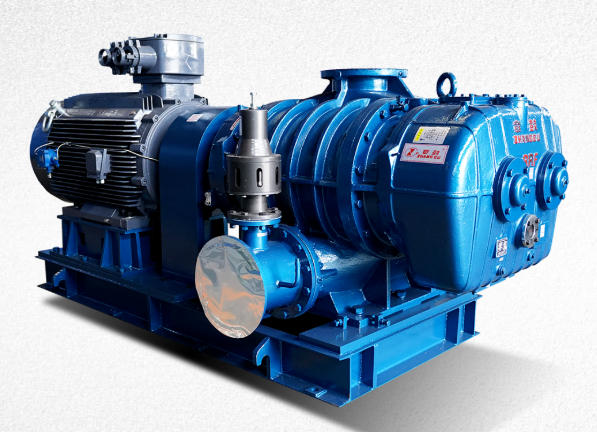
The air pressure in a Roots fan is not limited by its rotation speed. Regardless of changes in rotation speed, the air pressure remains constant. Air volume, on the other hand, is directly proportional to the fan speed, i.e., Q = KN.
Where:
Q — air volume;
N—fan rotation speed;
K is the coefficient.
From the formula it can be seen that the air volume is adjusted by changing the engine frequency using a frequency converter, which allows achieving stepless speed control and providing the effect of changing the air volume. Depending on the minimum frequency of the process fan in place, usually around 35 Hz, and sometimes running at 50 Hz with full air volume. Since the oven technology is basically the same, the amount of air volume adjustment in different ovens is also almost the same. Any furnace using variable frequency technology can achieve approximately 40% energy savings.
The Roots fan is a constant torque load. Its energy saving rate is proportional to the speed reduction, that is, N% = △N%. Although this rate is different from the energy saving characteristics of conventional fans and pumps, it has higher power and operates 24 hours continuously with a long service life. Therefore, the potential for energy saving is high and the cost of energy saving is high. After the technical transformation of the Roots blower, the production model was changed, based on regulating the pressure or volume of air by changing the opening degree of the exhaust (intake) valve. This made it possible to reduce labor intensity, improve the efficiency of adjustment, improve product quality and significantly reduce specific energy consumption.
Service and support
We have 42 offices throughout the country. In addition to Taiwan Province, all 33 provincial-level administrative regions have an extensive sales and service network. We can provide you with timely and convenient pre-sales, after-sales and after-sales services, understand your needs, continuously improve our service and quality systems, and meet our customers' individual requirements.